Embedded Firmware Intern · Indiana · Aug – Dec 2024
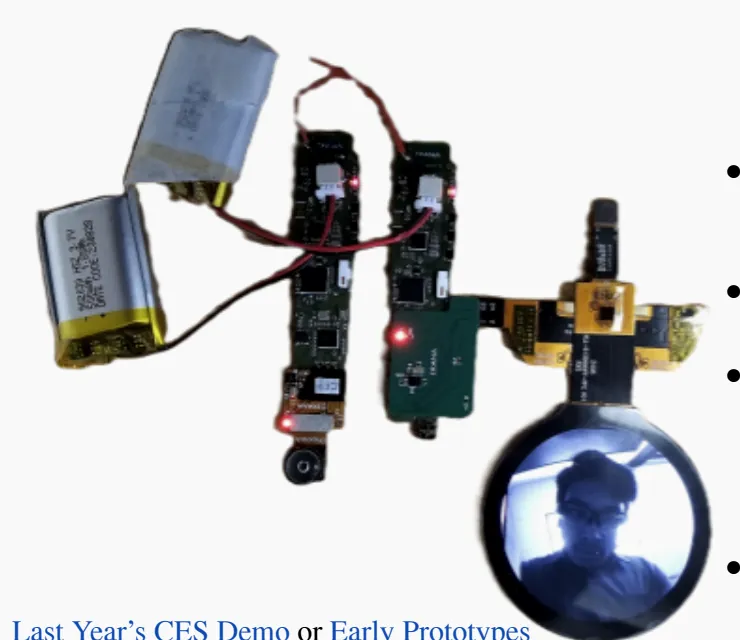
Built video streaming from smart glasses to a smartwatch over Ixana's Wi-R body-coupled silicon, using the body as an ultra-low-power data bus.
Streamed video from smart glasses to a watch through the body
Raised the frame rate from 4 to 13 fps
Owned the MIPI-DSI display drivers
Raised frame rate from 4 to 13 fps and cut power by 8% with a bare-metal C++ core OS on Ambiq and NXP MCUs. Debugged the whole path (camera, FPGA encode, MCU, Wi-R, MCU, FPGA decode, AMOLED), owned the MIPI-DSI display drivers, and wrote a Python driver for a Rigol waveform generator for HIL testing.
The project
A high-bandwidth video stream from smart glasses to a smartwatch over Ixana's YR22 silicon. It uses electro-quasistatic body communication, turning the wearer's body into a secure, ultra-low-power data bus that uses less power than Bluetooth or Wi-Fi.
What I did
I worked across the whole stack, from capture on the glasses through compression, transmission and decompression to the watch display, and was primarily responsible for the watch display drivers.
Bare metal: a power-efficient core OS in C++ for Ambiq and NXP ARM MCUs, scheduling real-time video tasks
System bring-up: debugged and helped build the full path, from camera to encoding FPGA, transmitter MCU, Wi-R silicon, receiver MCU and decoding FPGA to the AMOLED display
Signal integrity: resolved timing and data-encoding issues at the display interface
C++
Bare metal
Nordic
MIPI DSI
FPGA · Verilog
HIL
Media
CES demo: video sent through the body over Wi-R (full length, with audio)The video path: camera, FPGA, MCU, Wi-R, MCU, FPGA, displayWearable streaming demo